

Table of Contents
- Best Baby Bassinets for Small Spaces: Quick Comparison
- How to Measure Your Room Before You Buy
- Top Picks: Best Bassinets and Compact Sleepers for Small Bedrooms
- Portable Bassinet for Baby: What to Look For
- Bassinet Safety Standards You Should Verify
- Bassinet Alternatives for Small Spaces
- Which Bassinet Fits Your Space? A Decision Framework
- Frequently Asked Questions
Last Updated: October 21, 2026
Best Baby Bassinets for Small Spaces: Quick Comparison
Finding the best baby bassinets for small spaces comes down to one number: the footprint. A standard bassinet can eat up close to 4 square feet of floor, a lot when your "nursery" is a corner of a one-bedroom apartment.
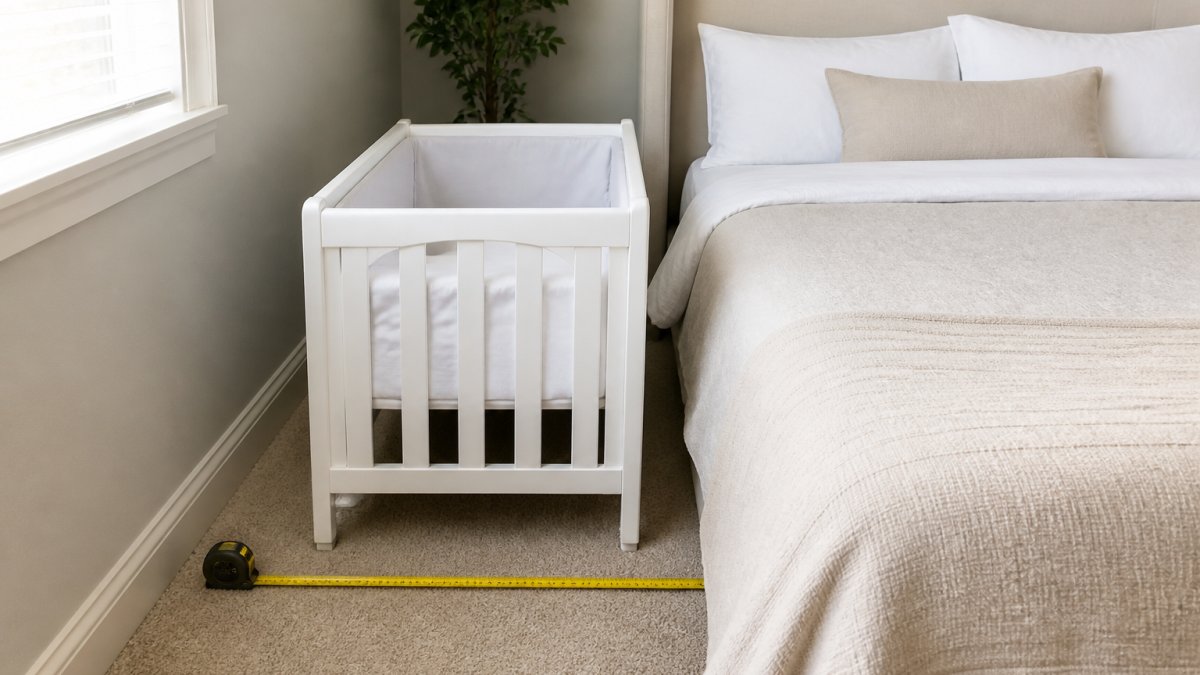
The short answer: for most tight rooms, a mini portable crib with locking wheels and a fold-flat frame gives the longest usable life per square foot.
Below, we compare seven compact options we carry, explain how to measure your room, and cover the safe-sleep standards to verify before your baby sleeps a night in any of them.
| Model | Price | Type | Standout Space Feature | Best For |
|---|---|---|---|---|
| California Dreaming Bedside Bassinet | $268.00 | Bedside bassinet | Folds to 5.9 in deep, 24.4 lb | Bedside sleeping and travel |
| Maverick Stand-Alone Bassinet | $289.00 | Stand-alone bassinet | Stand-alone frame, pairs with stroller | Parents who already own the matching stroller |
| Mia Portable Folding Mini Crib | $168.00 | Mini crib | Mattress included, folds flat | Best value for apartments |
| Orbelle Noa Tina Mini Portable Crib | $189.00 | Mini crib | 3-position height, locking casters | Best overall small-space pick |
| Orbelle Roxy Mini Portable Crib | $198.00 | Mini crib | Adjustable height, fold-flat frame | Nurseries that double as guest rooms |
| Orbelle Nathalie Mini Portable Crib | $189.99 | Mini crib | Locking wheels, solid wood | Shared bedrooms |
| Orbelle Lola Upholstered Cradle | $329.00 | Cradle | Anti-rock pin, 30 lb | Newborn stage with rocking |
How to Measure Your Room Before You Buy
Measure floor space, not wall space: what matters is the rectangle of floor the assembled frame occupies.

Measure three lines: frame length, frame width, and the walking gap you need past it. If the leftover strip is narrower than about 24 inches, you'll be sidestepping the crib every night, choose a narrower model.
Two more measurements catch most returns. Check door frame width against folded depth, a crib that folds flat but won't roll through the bedroom door isn't portable; the California Dreaming folds to 5.9 inches deep, clearing most doorways on its side.
Top Picks: Best Bassinets and Compact Sleepers for Small Bedrooms
Each pick earns its place for a different reason. We ranked them by usable sleep space per square foot of floor, then noted where each gives something up.
California Dreaming Bedside Bassinet
The California Dreaming is the pick if you want the baby at bed level and within arm's reach.
The fold makes it a small-space winner: it collapses to 5.9 inches deep and weighs 24.4 pounds, so it stores in a closet or car trunk. The aluminum frame has a bamboo fabric lining and compressed cotton mattress.
Where it falls short: this is a newborn-stage product. Once your baby starts pulling up, you will be shopping again.
Maverick Stand-Alone Bassinet
The Maverick is a stand-alone bassinet built as an add-on for the matching stroller, so it does double duty: sleep space at home and a lie-flat carrier when out. At $289.00 it only makes sense if you already own or plan to buy that stroller system, otherwise you're paying for compatibility you won't use.
For apartment parents who walk everywhere and want one piece of gear instead of two, that trade is worth it: it replaces a separate travel bassinet.
Mia Portable Folding Mini Crib
The Mia is the value pick and our most frequent recommendation for first-time apartment parents. At $168.00 it includes a 1.5-inch water-resistant mini crib mattress, so there's no separate purchase, and it folds flat with four smooth-rolling wheels.
Two details push it above its price class: GREENGUARD Gold Certification for tested chemical emissions and cleaner indoor air, plus JPMA certification and CPSC/ASTM compliance.
The honest limitation: two height positions is fewer than the three you get on the Orbelle models, and the finish options are limited to Bianca White/Natural.
Orbelle Noa Tina Mini Portable Crib
Our overall pick for small spaces is the Noa Tina. At $189.00 you get solid wood construction, a three-position tool-free adjustable mattress height, locking caster wheels, and a fold-flat frame.
The three-position height separates it from cheaper mini cribs: start high so you're not bending to the floor for a newborn, then drop it as your baby grows. Locking casters let you roll it from bedroom to living room by day and lock it at night, hard to beat at this price.
Orbelle Roxy Mini Portable Crib
The Roxy is the Noa Tina's slightly pricier sibling at $198.00, differing mostly in finish and frame detail: solid wood, classic slats, adjustable mattress heights, locking casters, and a fold-flat frame. Finishes are Cherry, Espresso, White, and Grey.
Buy the Roxy if you prefer its slatted look or one of its four finishes; buy the Noa Tina for the wider color range or lower price. The Roxy does not include a mattress, so budget for one separately.
Orbelle Nathalie Mini Portable Crib
The Nathalie lands at $189.99 and is built for shared bedrooms: solid wood, classic slats, locking casters, fold-flat storage, and adjustable mattress height, in Cherry, Espresso, Natural, and White. A straightforward, sturdy mini crib without extras.
It earns its recommendation in shared rooms: locking wheels let you reposition it by day, and the compact footprint keeps it from crowding a second bed.
Orbelle Noa Tina Mini Portable Baby Crib Folding with Adjustable Height →
Orbelle Lola Upholstered Cradle
The Lola is the one pick here that isn't a crib: an upholstered cradle at $329.00 with hardwood construction, padded and tufted head and footboards, and an anti-rock pin that locks it stationary. It measures 39.25 by 25.5 by 40 inches and weighs 30 pounds, light enough for one person to reposition.
A cradle suits the newborn stage specifically: rocking soothes, the anti-rock pin makes it safe as a stationary sleeper, and the smaller interior feels snug for a very young infant.
Portable Bassinet for Baby: What to Look For
A portable bassinet for baby needs three things to be genuinely portable: low weight, a fold that actually compacts, and wheels or a carry handle one person can manage alone.
Weight is the overlooked spec. Anything over about 30 pounds is a two-hand lift, impractical with a baby in the other arm. The California Dreaming (24.4 pounds) and Lola (30 pounds) both clear that bar.
Fold depth matters more than folded height: a frame folding to 6 inches deep slides behind a door or into a closet; one folding to 20 inches does not.
Bassinet Safety Standards You Should Verify
Safe sleep starts with meeting current federal rules: in the U.S., cribs and bassinets fall under CPSC regulations, and reputable manufacturers also test to ASTM standards. Verify three things before your baby sleeps in any sleep space.
First, confirm the product is certified to the current CPSC crib or bassinet standard and, where stated, ASTM. The CPSC recall database lets you search by brand and model in seconds, and it is the single fastest safety check a parent can run.
Third, follow the sleep setup rules that apply to every product on this list. The safe sleep guidance from the NIH is clear: place babies on their backs, on a firm, flat surface, with a fitted sheet and nothing else in the sleep space.
Bassinet Alternatives for Small Spaces
A mini crib is the most practical bassinet alternative for small spaces: same job, similar footprint, months longer use.
The Mia makes the case plainly: a portable folding mini crib with included mattress, wheels, and fold-flat frame, costing less than two of the bassinets here.
A cradle is the other alternative, right if you specifically want rocking motion for the newborn months, but know it's a stage, not a long-term purchase.
Weighing a mini crib against a full-size convertible crib for a small nursery?
Which Bassinet Fits Your Space? A Decision Framework
Use this framework to pick in under five minutes. Start with your available floor rectangle, then match the scenario.
- Under 24 inches of clearance beside the bed: choose a bedside bassinet like the California Dreaming, which folds to 5.9 inches deep and stores away when not in use.
- Room shared with a guest bed or a desk: choose a mini crib with locking wheels, like the Nathalie or the Noa Tina, so you can roll it out of the way.
- You want one purchase that lasts past six months: choose a mini crib, not a bassinet. The Mia at $168.00 is the value pick; the Noa Tina at $189.00 adds a third height position and six finishes.
- You already own the matching stroller system: the Maverick at $289.00 replaces a separate travel bassinet.
- You want rocking motion for the newborn stage and nothing more: the Lola cradle at $329.00, with the anti-rock pin for stationary sleep.
- You travel often or visit family: prioritize fold depth and weight. The California Dreaming folds to 5.9 inches and weighs 24.4 pounds.
One caveat: check the manufacturer's height and weight limits for the specific model, since mini cribs and bassinets have different ceilings. A product that fits your room is only right if it also fits your baby's stage.
Small-space nursery planning comes down to measuring twice and buying once, and the wrong pick usually shows up as a return within the first month.
Frequently Asked Questions
What size is too big for a bassinet in a small space?
A bassinet that takes up more floor space than the clear path around your bed or doorway is too big. Measure the open floor area first, then compare the bassinet's footprint. The California Dreaming Bedside Bassinet, for example, has an open size of about 39.4 by 19.9 inches, so it fits a narrow bedside gap. If your room cannot spare roughly 20 inches of width beside the bed, choose a folding mini crib or a cradle and keep the sleep space against one wall.
Can a portable bassinet for baby be used as the main sleep space?
Yes, many portable bassinets are designed for overnight sleep, not just naps. Check the manufacturer's age and weight limits, and confirm the product meets current CPSC bassinet requirements. A portable bassinet for baby works as a primary sleeper only while your child stays within those limits, usually until they can roll over or push up. After that, move to a crib or mini crib. Always use a firm, fitted mattress and keep the sleep area free of pillows, blankets, and toys.
What bassinet safety standards should I check before buying?
Look for a label stating the bassinet meets CPSC safety requirements and ASTM F2194, the standard for bassinets and cradles. Check that the product has a sturdy base, locking wheels or casters, and breathable mesh sides for airflow. Avoid any bassinet with soft bedding or an inclined sleep surface. Also register the product with the manufacturer so you receive recall notices. You can check recalls at CPSC.gov before you buy and again after assembly.
What is a good bassinet alternative for small spaces?
A mini crib or a folding portable crib is a practical bassinet alternative for small spaces. The Mia Portable Folding Mini Crib, for instance, measures about 39 inches wide by 25 inches deep when assembled and folds to roughly 6.25 inches deep for storage. Mini cribs last longer than most bassinets and use standard 24 by 38 inch sheets. A rocking cradle with an anti-rock pin is another option for tight rooms, but check its dimensions against your floor plan first.
How do I measure a room before choosing a bassinet?
Measure the width and depth of the open floor area where the bassinet will sit, then subtract at least 12 inches on each side for a safe walkway. Note door swing clearance and the distance to outlets and windows. Write down the bassinet's assembled dimensions and its folded dimensions if you plan to store it. A compact footprint of about 20 inches wide by 40 inches long fits most small bedrooms, but confirm you can still open dresser drawers and reach the bed.
