

Last Updated: November 4, 2026
Quick Summary
A toddler bed typically lasts about two to three years, and most children move out of it between ages 4 and 5. The bed's weight and height limits, not the calendar, decide when your child has outgrown it.
- Children usually start using a toddler bed between 18 months and 3 years.
- Check the manufacturer's label for the weight limit and height guidance.
- Start planning the next bed within about 10 pounds of the limit.
- The typical age to transition from toddler bed to twin is 4 to 5 years old.
- Recheck bolts, rails and the weight limit against your child quarterly.
Table of Contents
- How Long a Toddler Bed Lasts, From Ages 2 to 5
- Toddler Bed Weight Limit and Height Limit: What the Numbers Actually Mean
- Signs Your Child Is Ready for a Twin Bed
- What Age to Transition From Toddler Bed to Twin
- Toddler Bed vs Twin Bed: A Decision Framework
- Safe Setup and Inspection as Your Child Grows
- Choosing a Toddler Bed That Earns Its Years
- Frequently Asked Questions
How Long a Toddler Bed Lasts, From Ages 2 to 5
Most parents ask how long can a child use a toddler bed, and the honest answer is that the bed itself has a lifespan of roughly two to three years, while the child's readiness to leave it usually arrives between ages 3 and 5. A toddler bed is a low-profile sleep space sized for a standard crib mattress, designed to bridge the gap between a crib and a full twin bed.
The confusion comes from mixing two different timelines. One is the age a child starts using the bed. The other is how long that same bed stays useful.
- Starting age: commonly around 18 months to 3 years, once a child climbs out of the crib or outgrows it
- Typical useful life: about two to three years, often ending between ages 4 and 5
- Hard stop: the bed's own weight and height limits, not the calendar
A child who moves into a toddler bed at 2 will usually outgrow it by 4 or 5. A child who transitions later, closer to 3, may only get a couple of years out of it. That is normal, and it is why the next section matters more than any age chart.
Toddler Bed Weight Limit and Height Limit: What the Numbers Actually Mean
The toddler bed weight limit is the number that decides when the bed stops being safe, and limits differ by model, so always check the specific bed's manual rather than assume. Height limits are less standardized but equally important: a child who can sit up tall enough to tip over a guardrail has outgrown the rails, even if the scale says otherwise.
A weight limit is not a suggestion. It reflects the load the frame, slats, and support legs were tested to hold, including the mattress and bedding. Exceeding it can crack slats, bend the frame, or cause a leg to fold, and the failure often happens at night when a child rolls or climbs.
Here is how to check a specific bed, in order:
- Find the manufacturer's label on the bed frame, usually on the inside of a side rail or the underside of the headboard, and in the assembly manual.
- Note the stated upper weight limit and any height guidance. If the manual is missing, look for a model number stamped on the frame and request documentation from the manufacturer.
- Weigh and measure your child at each well-child visit, and write the numbers down so you can compare them over time.
- Compare, and start planning the next bed once your child is within about 10 pounds of the limit or their shoulders reach the top of the guardrail.
Watch out: the 50-pound figure is a common ceiling, not a universal one, and a hand-me-down bed with a missing manual leaves you guessing. The Consumer Product Safety Commission guidance on toddler beds is the place to confirm current federal safety requirements when documentation is missing, and it can help you identify whether a secondhand bed meets the standards it was sold under.
A simple way to estimate remaining life is to subtract your child's current weight from the bed's limit and divide by the average annual gain for their age. Height usually becomes the binding constraint first, which is why the guardrail check belongs in every quarterly inspection.
Signs Your Child Is Ready for a Twin Bed
A child is ready for a twin bed when they approach the bed's weight or height limit, climb out safely and frequently, or simply no longer fit comfortably, which typically happens between ages 4 and 5. Age alone is a weak signal. The bed's limits and your child's behavior tell you more.
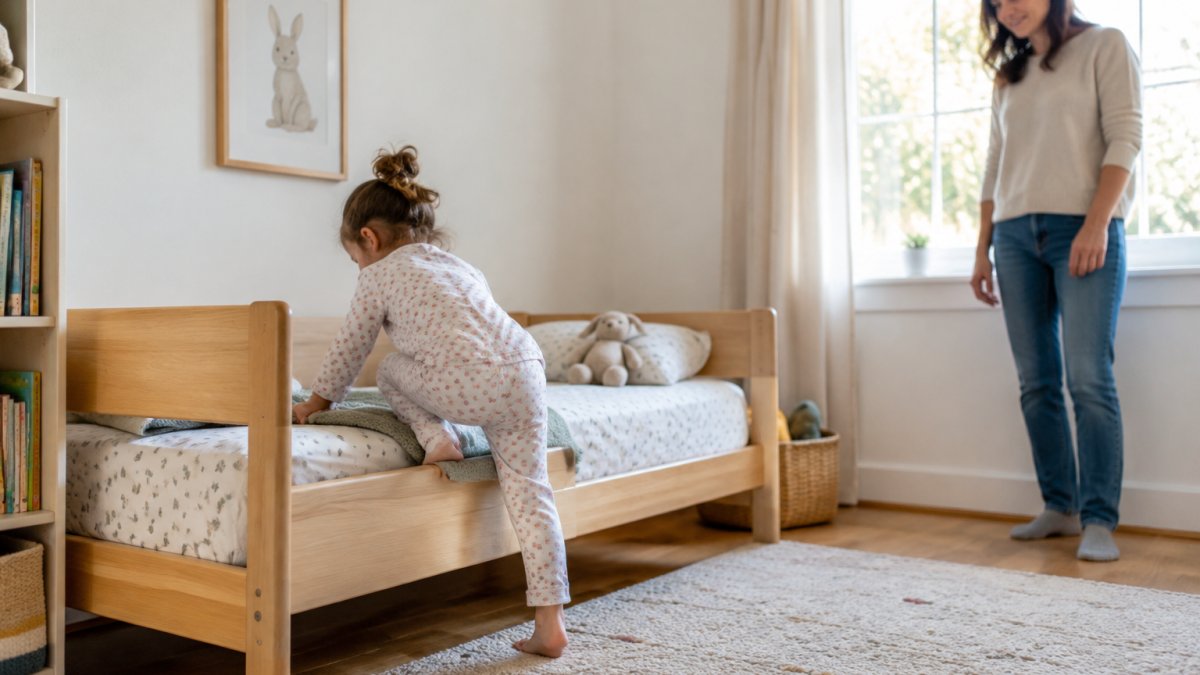
Behavioral signs of outgrowing the bed go beyond the scale:
- The guardrails sit low against your child's back when they sit up
- Your child's feet press against the footboard
- They ask for a "big kid bed" or resist bedtime in the current one
- They have started sleeping on the floor or in a sibling's room instead
If two or more of these apply, the toddler bed has done its job. When you are ready to shop, consider a floor bed twin size for the next stage. The signs your child is ready for a twin bed are rarely dramatic, which is exactly why parents miss them.
What Age to Transition From Toddler Bed to Twin
The typical age to transition from toddler bed to twin is between 4 and 5 years old, though the right moment depends on size and temperament as much as birthday. Some children are ready at 3 and a half; others comfortably stay in a toddler bed past 5 if they are small and sleep well.
The decision belongs to you and your child's measurements. A few practical markers help:
- Your child has hit the bed's weight limit or is within a few pounds of it
- They have outgrown the length of a standard crib mattress
- Bedtime has become a negotiation every night
- You are expecting another child who will need the crib or toddler bed
Resistance is common and worth planning for. Children attach to familiar sleep spaces, so a gradual introduction, letting them pick bedding or a small lamp, tends to smooth the switch more than a sudden swap. Keeping bedtime rituals familiar as the child adjusts can also support a consistent sleep schedule through the transition.
Toddler Bed vs Twin Bed: A Decision Framework
Choosing between a toddler bed and a twin bed comes down to more than age.
Anna Classic Toddler Bed with Built-In Safety Rails →
Start with the limits. A toddler bed suits a child under the weight limit who still needs low height and rails. A twin bed suits a child near those limits who is ready for a longer-term sleep space.
Then compare the practical trade-offs:
| Factor | Toddler Bed | Twin Bed |
|---|---|---|
| Typical age range | 2 to 5 years | 4 years and up |
| Mattress | Standard crib mattress | Twin mattress |
| Height off floor | Low, easy access | Higher, may need rails |
| Lifespan | About 2 to 3 years | Often 5+ years |
| Footprint | Small, fits tight rooms | Larger, needs clearance on at least one side |
| Safety equipment | Built-in rails on most models | May need a separate bed rail |
| Best for | First transition, small rooms | Outgrowing the toddler bed |
Cost is where the decision often turns. A toddler bed usually costs less up front and lets you reuse the crib mattress, so the immediate outlay is smaller. When you price out the twin side, a twin mattress option helps you see the full cost before you commit.
Room layout matters as much as budget. A toddler bed fits where a twin will not, and in a small room that alone can decide the question. Measure the available wall space and leave at least two feet of clearance on the side your child uses to get in and out.
Finally, weigh temperament. A child who is proud of a "big kid bed" and sleeps well through changes will likely take to a twin without much trouble.
Safe Setup and Inspection as Your Child Grows
Safe setup starts the day the bed arrives and continues every few months as your child grows. A toddler bed that was secure for a 2-year-old can become a fall risk for a taller, heavier 4-year-old if the rails and frame are not rechecked.
Run through this inspection checklist quarterly:
- Tighten all bolts and screws on the frame and rails
- Confirm the mattress sits flush with no gaps at the edges
- Check that guardrails are firmly attached and at the right height
- Look for cracked slats or loose support legs
- Clear the floor around the bed of hard toys and furniture corners
- Recheck the weight limit against your child's current weight
A common mistake is assuming a bed assembled correctly once stays correct. Children bounce, lean, and climb. The frame loosens. Five minutes with a wrench every few months prevents most of the problems parents worry about.
Choosing a Toddler Bed That Earns Its Years
A toddler bed earns its years when it fits a standard crib mattress, carries built-in rails, and sits low enough for a child to get in and out without help. Those three features do more for safety and longevity than any decorative detail.
At Bungle Nursery Cribs, several of our toddler beds are built around exactly that. The Anna Classic Toddler Bed with Built-In Safety Rails is sized to fit a standard crib mattress, so your child keeps the mattress they already know, and features two built-in guardrails, a low-profile design and reinforced mattress slats on six support legs. For a solid wood alternative, the Orbelle Classic Solid Wood Toddler Bed With Safety Rails Standard Size offers dual guardrails and is available in several finishes. Families who want something softer can compare the padded upholstered toddler bed with safety rails, which adds a cushioned headboard and footboard without giving up the rails.


The Anna Classic Toddler Bed is sized to accommodate a standard crib mattress, so your child can keep the mattress they already know.
The transition out of a toddler bed sneaks up on most families, usually somewhere between the fourth and fifth birthday, and the bed's weight and height limits decide the timing better than any age chart. If you are ready to plan the next step, Bungle Nursery Cribs carries toddler beds with built-in safety rails, free standard shipping on every order, and expert customer support to help you match the right bed to your child's measurements. Get started with Bungle Nursery Cribs and choose a bed that fits your child today and for the years ahead.
Frequently Asked Questions
Can a 5-year-old still use a toddler bed?
Many 5-year-olds still fit, but it depends on the specific bed rather than age alone. Most toddler beds are built for a standard crib mattress and list an upper weight limit around 50 pounds, with height limits that keep a child from rolling over the guardrails. A 5-year-old who is small for their age may sleep comfortably for another year. A taller or heavier 5-year-old is usually better off in a twin bed, since a toddler bed frame and mattress leave little room to stretch.
What is the weight limit for a standard toddler bed?
The toddler bed weight limit varies by model, so check the manufacturer's label rather than assuming. Toddler bed weight limits vary by model, so check the manufacturer's label for the upper limit. That figure covers the frame, the mattress support slats and the guardrails together. If your child is within about 10 pounds of the limit, start planning the move to a twin bed. A bed should never carry a child above its listed limit, even if the frame looks sturdy.
Is a toddler bed necessary before moving to a twin bed?
Not always. A toddler bed suits families who want to reuse the crib mattress and keep a low, familiar sleep space during the crib-to-bed transition. If your child is already climbing well, is tall for their age, or has outgrown the crib mattress, going straight to a twin bed with a guardrail can save a purchase. The main trade-off is height: a twin bed sits higher off the floor, so add a rail and keep the landing area clear.
How do I know when my child has outgrown the toddler bed?
Watch for four signs beyond age. Your child's head or feet reach the ends of the mattress, they roll into the guardrail or fall out at night, they climb out easily and wander, or their weight nears the bed's listed limit. Any one of these means it is time to measure. Check the bed's height and weight limits against your child's current measurements, then compare those numbers with a twin bed frame before you buy.

