

Last Updated: November 1, 2026
Quick Summary
To learn how to choose a crib mattress for a mini crib, measure your crib's interior at the mattress support level, since mini cribs have no universal size and a common reference is 24 by 38 inches. Match the mattress to those exact dimensions and the crib's maximum thickness, then run the two-finger gap test before the first sleep.
- Measure the crib interior from slat to slat in both directions before buying any mattress.
- The mattress should touch all four sides with no gap wider than two fingers.
- Most mini crib mattresses fall between 3 and 6 inches thick, and firmness matters more than thickness.
- Foam mattresses dominate the mini crib category because they are lighter and easier to fold.
- Re-run the fit test after any support-height adjustment, fold, move, or new mattress.
Table of Contents
- Mini Crib Mattress Dimensions: Why Exact Measurements Matter
- How to Run a Mini Crib Mattress Fit Test at Home
- Mini Crib Mattress Thickness: How Thick Is Safe?
- Foam vs. Innerspring Crib Mattress: Which Belongs in a Mini Crib?
- Firmness, Safety Standards, and What to Verify Before Buying
- Mini Crib Use Cases and Portability Trade-Offs
- Choosing Your Mini Crib Mattress at Bungle Nursery Cribs
- Frequently Asked Questions
Mini Crib Mattress Dimensions: Why Exact Measurements Matter
A mini crib mattress must match your specific crib's interior dimensions, because mini cribs do not share one universal size. To see mini portables whose dimensions your mattress must match, browse the mini portable cribs.
This guide from Bungle Nursery Cribs covers how to choose a crib mattress for a mini crib, including measurements, the fit test, thickness limits, and materials.
Mini cribs fit apartments, shared bedrooms, and grandparents' homes. Standard crib mattresses follow a common size, while mini crib mattresses are not held to a single national dimension, so manufacturers set their own specs.
Standard vs. Mini Crib Sizes
A standard crib mattress is considerably larger than a mini crib mattress, which typically measures about 24 by 38 inches. That foot-plus difference in length is why you cannot trim a standard mattress or squeeze one into a mini frame.
| Crib Type | Typical Mattress Size | Fits Sheets |
|---|---|---|
| Standard crib | About 27.25" x 51.625" | Standard crib sheets |
| Mini crib | About 24" x 38" | 24" x 38" mini crib sheets |
| Portable folding crib | Varies by model | Check crib manual |
Treat those numbers as a starting point, not a guarantee. Measure the inside of your crib frame from slat to slat in both directions before you buy anything.
Mini Crib Dimensions Are Not One Uniform Size
The 24 by 38 inch figure is a common reference point, not a standard. A frame built for a 23.5 by 37.5 inch mattress will leave a visible gap around a true 24 by 38 inch mattress, and that gap is the hazard, not the number on the box.
Mini cribs also come in several configurations that change the mattress you need:
- Stationary mini cribs with fixed slat frames and fixed mattress support height.
- Portable or folding mini cribs where the mattress support may be a fabric or hinged platform rather than a rigid panel.
- Convertible mini cribs that adjust to a toddler bed or daybed, where the mattress may need to fit both configurations.
Because of that variation, the only reliable source for your crib's mattress size is the crib itself. Check, in this order:
- The crib manual or assembly instructions. Look for a mattress size or maximum thickness spec; many manuals state both.
- A label on the crib frame or mattress support. Some manufacturers affix a sticker listing recommended dimensions.
- The manufacturer's website or customer service line. The model number on the frame is usually enough to confirm the spec.
- The mattress label. If you already own a mattress, the label lists its dimensions, materials, and care instructions.
How to Measure Your Mini Crib Interior
Measure the crib interior yourself before shopping. You need two numbers: the interior length and the interior width, taken at the mattress support level.
- Remove the mattress and bedding so the support is fully exposed.
- Measure from the inside face of one end panel to the inside face of the opposite end panel. Record the length.
- Measure from the inside face of one side panel to the inside face of the opposite side panel. Record the width.
- Measure at the mattress support level, not the top rail, since sloped or tapered frames can differ.
- Repeat at both ends and take the smaller number if they differ.
Compare your measurements to the mattress you are considering. The mattress should touch all four sides with no gap wider than two fingers. A mattress that is even half an inch narrow can create a gap along one side.
Finding a Compatible Replacement Mattress
If the original mattress is missing, worn, or discontinued, finding a replacement is a measurement exercise, not a brand exercise. Thickness and dimensions both matter: a mattress that matches in length and width but exceeds the crib's maximum thickness can raise the sleep surface too close to the top rail.
A practical replacement workflow:
- Identify the crib model on the frame, manual, or manufacturer's website.
- Confirm the specified mattress size and maximum thickness with the manufacturer if the manual is unavailable.
- Measure the interior yourself as a cross-check.
Mini Crib Sheets and Fit
A sheet that is too large can bunch under a baby; one that is too small can pull the mattress corners up. Use sheets sized for your mattress dimensions, commonly 24 by 38 inches for mini cribs, and check that the sheet fits snugly with no loose fabric on the sleep surface.
How to Run a Mini Crib Mattress Fit Test at Home
A mini crib mattress passes the fit test when it touches all four sides of the frame with no gap wider than two fingers anywhere around the perimeter. Run this test before the first sleep, then repeat it whenever you adjust the support height, move the crib, or change the mattress.
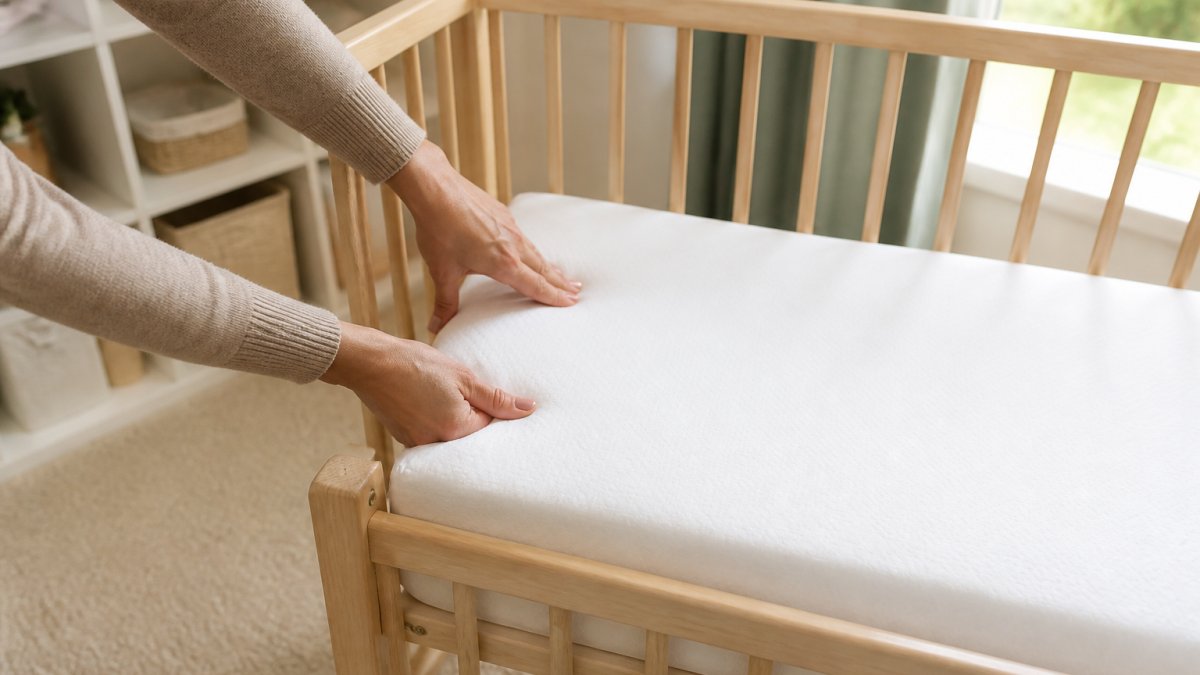
Here is the sequence we recommend:
- Lower the crib side or remove bedding so you can see the full mattress edge.
- Press the mattress into one corner, then check the opposite corner for daylight or a visible gap.
- Slide your hand around all four sides. If two fingers fit between mattress and frame, the fit is too loose.
- Press down on the center. The mattress should feel firm and should not compress more than a shallow indent.
- Check that the mattress sits flush against the support, with no corner riding up.
The Two-Finger Gap Rule
The two-finger gap rule is a simple home check: if you can slide two fingers into the space between the mattress and the crib frame, the mattress is too small. Gaps are the real hazard, a baby's limb or face can become trapped in one during sleep.
If your mattress fails this test, do not pad the gap with blankets, towels, or foam wedges. Those additions create soft surfaces and new entrapment risks. Return the mattress and find one sized to your crib's exact interior.
Checking Corners, Edges, and Mattress Movement
Most fit failures show up at the corners first. A mattress slightly short in one dimension can still touch along the middle of each side while leaving a triangular gap at one or more corners. Check each corner individually: Ensuring that no more than two fingers can fit between the mattress and the frame is essential for safety, though parents should also consider how alternative sleeping options might better suit their nursery space.
- Corner gaps. Press the mattress diagonally into one corner and look at the opposite corner. A visible gap means the mattress is too small in that dimension.
- Edge gaps. Run your hand along each side. A gap along one full edge usually means the mattress is narrow in that direction.
- Movement. Press down near one corner and watch the opposite corner. If the mattress lifts, slides, or rocks, it is not seated correctly.
Fit on Different Mattress Support Types
Mini cribs use different mattress support designs, and each affects how the fit test behaves:
- Rigid panel supports hold the mattress flat and make gap checks straightforward.
- Fabric or hinged platform supports, common on folding and portable mini cribs, can shift when the crib is folded or moved. Re-run the fit test after every fold and unfold, and check that the platform is fully locked before use.
- Adjustable-height supports change the mattress position as the baby grows. Re-check the fit after each height adjustment.
What to Do If the Fit Fails
A failed fit test is a return-and-replace situation, not a fix-it-yourself situation. Remove the mattress from use and find one sized to your crib's exact interior dimensions. If it came with the crib, contact the crib manufacturer for the specified replacement size.
Document your measurements, interior length, interior width, and the crib's maximum thickness if listed, so you can compare them to any replacement spec and speed up a return or exchange.
Two Stage Breathable Mini Crib Mattress With Washable Waterproof Cover →
When to Stop Using a Mattress
Replace a mini crib mattress if it no longer passes the fit test, if the core has softened or developed a visible indent, if the cover is torn and the core is exposed, or if it no longer matches the crib's specified dimensions. Foam compresses over time, so re-check fit periodically.
Mini Crib Mattress Thickness: How Thick Is Safe?
Most mini crib mattresses fall between 3 and 6 inches thick, and thickness matters less than firmness and a flat, level sleep surface. A thicker mattress is not automatically safer or more comfortable for an infant.
What to check instead:
- Support height limits. Some mini cribs specify a maximum mattress thickness. Exceeding it can raise the sleep surface too close to the top rail.
- Flush fit. The mattress should sit level inside the frame, not perch above it.
- Firmness over padding. Infants need a firm sleep surface; a plush, deep mattress works against that.
A common mistake is buying the thickest mattress available assuming it means better quality. In a mini crib, frame clearance and a firm surface do more for safety than an extra inch of foam.
Foam vs. Innerspring Crib Mattress: Which Belongs in a Mini Crib?
Foam mattresses dominate the mini crib category because foam is lighter, easier to fold with a portable crib, and easier to move.
| Feature | Foam | Innerspring |
|---|---|---|
| Weight | Lighter | Heavier |
| Portability | Easier to lift and reposition | Harder to move |
| Feel | Firm, uniform | Firmer edge, springy center |
| Price range | Generally lower | Generally higher |
| Best for | Portable and folding mini cribs | Stationary mini cribs |
Neither option is unsafe when it meets current safety standards and fits the frame snugly. You can browse crib mattresses to compare foam and innerspring options for your mini crib. The decision usually comes down to whether the crib moves.
Materials, Covers, and Breathability
Look for a waterproof cover and a breathable sleep surface, especially in a small room where airflow is limited. Breathability helps with temperature regulation, and a waterproof layer keeps spit-up and leaks from soaking into the core.
Our organic crib mattresses collection is worth browsing if you want to compare material options side by side.
One example from our catalog is the Two Stage Breathable Mini Crib Mattress With Washable Waterproof Cover at $189.00, which features a two-stage sleep system, a removable machine-washable breathable cover, and a food-grade waterproof layer, and is EWG VERIFIED®.
Firmness, Safety Standards, and What to Verify Before Buying
A safe mini crib mattress is firm, flat, and certified. Firmness matters because a soft surface can conform to a baby's face and interfere with breathing. Flatness matters because inclined or uneven surfaces are not recommended for infant sleep.
Before you buy, verify these items:
- Certification. Look for GREENGUARD Gold certification for low chemical emissions, and check the label for any certification it carries.
- Firmness claim. The infant side should feel rigid, not springy or cushioned.
- Fit confirmation. Confirm dimensions against your crib manual, not just the product listing.
For a deeper walkthrough of certifications and construction, our crib mattress buying guide covers the full checklist. Current safety guidance from the U.S.
Mini Crib Use Cases and Portability Trade-Offs
Portability is the main reason parents pick a mini crib, and the trade-offs show up in the details. The Orbelle Nathalie Mini Portable Baby Crib With Locking Wheels is one model to consider.
Mini cribs suit several situations:
- Apartments and small nurseries where a full-size crib crowds the room.
- Room sharing during the first months, when the crib sits beside the parents' bed.
- Grandparents' homes that need a safe sleep space without a permanent nursery.
If you are shopping for a mini crib with locking wheels, the Orbelle Noa Tina Mini Portable Baby Crib with Adjustable Height is one option to look at, and the Orbelle Roxy Mini Portable Folding Baby Crib is another compact, portable choice.
Choosing Your Mini Crib Mattress at Bungle Nursery Cribs
The safest mini crib mattress is the one that fits your exact frame, stays firm, and comes with a washable cover.
At Bungle Nursery Cribs, we offer compact mattresses and mini cribs, with free standard shipping on every order, a price match guarantee, and 24/7 expert customer support if you are unsure which size fits your model.
Get started with Bungle Nursery Cribs and set up a mini crib sleep space that fits right the first time.
Frequently Asked Questions
Can a regular crib mattress fit in a mini crib?
No. A standard crib mattress measures roughly 28 by 52 inches, while most mini cribs take a mattress around 24 by 38 inches. Forcing a full-size mattress into a mini crib frame creates gaps along the rails and an uneven sleep surface, both of which are unsafe for infants. Always match the mattress to the crib's stated dimensions and confirm the fit with a gap test before the first sleep.
Are mini crib mattresses a standard size?
Not reliably. Many mini cribs use a 24 by 38 inch mattress, but folding and portable models vary by brand and model, so two mini cribs can require different mattresses. Check the crib's label or manual for the exact mattress dimensions and support weight limit, then measure the mattress you buy against those numbers. A mini crib mattress that is even an inch off can leave a dangerous gap.
How thick should a mini crib mattress be?
Most mini crib mattresses fall between 3 and 6 inches thick. Thickness matters less than firmness and fit: the mattress should sit flat and snug inside the frame with no more than two fingers of space at any edge. A thicker mattress can raise the sleep surface closer to the rail, so confirm the crib's minimum and maximum mattress height before buying.
Should I choose a foam or innerspring mini crib mattress?
Foam mattresses are lighter, easier to lift when changing sheets, and often cheaper, which suits portable mini cribs that move between rooms. Innerspring mattresses feel firmer and more supportive and tend to hold their shape longer, but they weigh more. Whichever you pick, confirm a firm, flat surface, a waterproof cover, and a snug fit inside your specific crib frame.

